Custom NFC, RFID and Smart Card Manufacturer
100M+ Cards Annually | Original NXP Chips | Since 2011


 2026.10.29


Healthcare providers and medical device manufacturers need reliable ways to identify products, manage inventory, verify product information, and support traceability throughout the supply chain. From blood collection systems and infusion consumables to surgical instruments and medical equipment, accurate product identification plays an important role in healthcare operations.
RFID and NFC technologies offer additional options for identifying and tracking medical products. Depending on the application, they can support automated inventory counting, asset identification, product authentication workflows, and access to digital product information.
Union Smart is an RFID and NFC tag manufacturer providing customized tag solutions for different product structures and identification requirements. By evaluating the application environment, tag dimensions, operating frequency, reading distance, and integration requirements, healthcare manufacturers and solution providers can select a suitable tag design for their projects.
Why Does Healthcare Need Better Product Traceability?
Medical products move through multiple stages, including manufacturing, packaging, warehousing, distribution, hospital receiving, storage, and clinical use. At each stage, accurate identification helps organizations maintain reliable product records.
Common challenges include:
Inventory visibility: Knowing which products are in stock, where they are located, and when replenishment is needed.
Batch and expiry management: Supporting the identification of product batches and expiry dates when this information is encoded or associated with the product record.
Product identification: Distinguishing product models, specifications, and individual items where required.
Recall management: Helping locate affected products when a manufacturer initiates a recall.
Operational efficiency: Reducing repetitive manual data entry and supporting faster inventory checks.
Barcode-based identification remains widely used in healthcare. RFID can complement barcode systems when non-line-of-sight reading, bulk scanning, or automated identification offers operational advantages.
The appropriate solution depends on the product, workflow, regulatory requirements, and existing hospital information systems.
Healthcare Applications for RFID and NFC Tags
Medical Consumables and Inventory Management
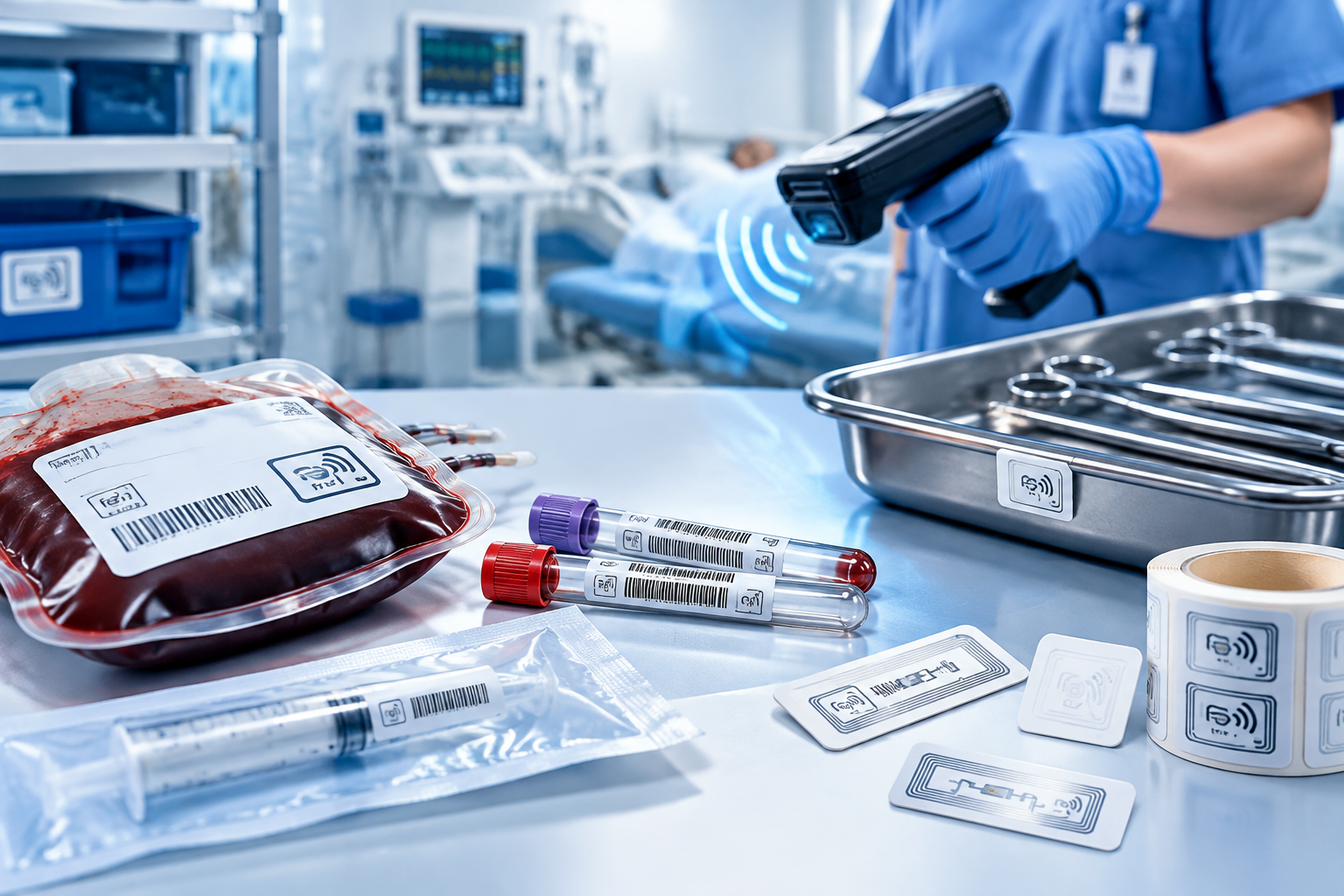
Medical consumables include syringes, infusion sets, dressings, procedure kits, and other single-use products.
In suitable applications, RFID tags can be attached to product packaging, cartons, trays, or designated containers. RFID readers can then identify tagged items without requiring each tag to be visually aligned with a scanner.
Blood Bags and Blood Collection Systems
Blood bags, blood collection tubes, and related collection or transfusion products require accurate identification and controlled handling.
RFID may be considered for selected workflows, such as inventory management, container identification, logistics, and cold-chain operations. A tag can be associated with a record containing the relevant product or container information.
Surgical Instruments and Reusable Medical Devices
Reusable surgical instruments and medical equipment may pass through multiple stages of use, cleaning, sterilization, storage, and redistribution.
RFID can support identification and tracking when a suitable tag can withstand the required operating environment.
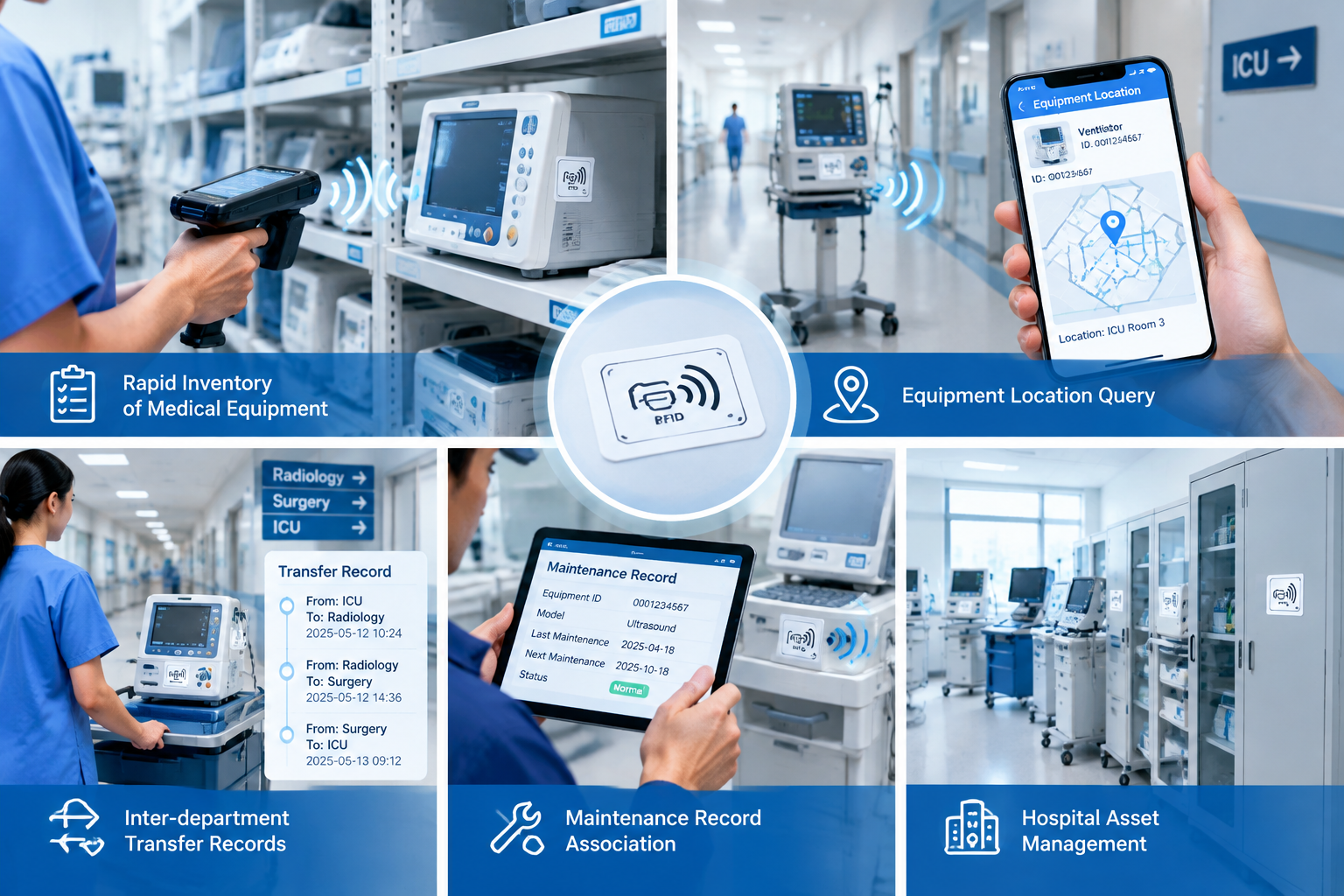
Potential applications include:
Identifying instrument trays and reusable containers.
Tracking selected reusable instruments.
Recording equipment movements between departments.
Supporting sterilization workflow records.
Locating tagged medical equipment.
Tag durability is a key selection factor. Depending on the process, tags may need to tolerate repeated cleaning, disinfectants, moisture, heat, pressure, or sterilization cycles.
A tag intended for ordinary warehouse inventory should not automatically be assumed suitable for an autoclave or repeated medical reprocessing. The complete tag assembly must be validated under the actual operating conditions.
Medical Equipment and Asset Tracking
Hospitals manage equipment across operating rooms, laboratories, wards, storage areas, and maintenance departments.
RFID can help organizations identify tagged equipment and improve visibility into its location and movement. Depending on the system design, fixed readers, handheld readers, or RFID-enabled cabinets may be used.
Typical applications include:
Locating portable medical equipment.
Recording equipment transfers.
Supporting periodic asset inventories.
Associating maintenance records with equipment identifiers.
Reducing time spent searching for tagged assets.
These applications generally require integration between RFID readers, asset-management software, and the hospital's existing information systems.
NFC for Medical Product Information and Authentication
NFC is a short-range contactless technology commonly used with compatible smartphones and NFC readers.
For selected healthcare applications, an NFC tag can provide access to a digital product record or an authorized information page.
Potential applications include:
Accessing equipment instructions and maintenance information.
Retrieving product information associated with a unique identifier.
Supporting product verification workflows.
Providing authorized personnel with digital documentation.
Linking reusable equipment to service records.
NFC should not be treated as a substitute for mandatory UDI labeling or an independently sufficient guarantee of product authenticity. Authentication strength depends on the chip's security features, cryptographic implementation, backend verification, and system design.
UDI and RFID: What Is the Difference?
UDI stands for Unique Device Identification. It is a regulatory identification framework for medical devices, not a specific tag technology.
A UDI system generally includes:
UDI-DI (Device Identifier): Identifies the device and its relevant model or packaging configuration.
UDI-PI (Production Identifier): Identifies applicable production information, such as a lot number, serial number, manufacturing date, or expiry date.
UDI data carrier: The machine-readable carrier used to convey the identifier.
UDI database: Stores the associated device identification information.
Depending on the applicable regulations and product requirements, a UDI data carrier may use a one-dimensional barcode, a two-dimensional barcode, or an RFID tag. Under China's UDI rules, when an RFID tag is used as the UDI data carrier, the required one-dimensional or two-dimensional barcode must also be provided.
How to Select RFID or NFC Tags for Healthcare Applications
A healthcare tag should be selected according to the intended use rather than by chip type alone.
Frequency and Reading Requirements
Different RFID frequencies serve different purposes:
LF RFID: Used in selected short-range identification applications.
HF RFID / NFC (13.56 MHz): Suitable for short-range identification and applications requiring compatible NFC readers or smartphones.
UHF RFID: Often considered for inventory management, logistics, and bulk identification where longer reading distances are useful.
The best choice depends on the reading environment, tag orientation, reader configuration, nearby materials, and required reading performance.
Customized RFID and NFC Tag Manufacturing by Union Smart
As an RFID and NFC tag manufacturer, Union Smart can work with healthcare product manufacturers, distributors, and system integrators to evaluate tag requirements for specific identification and traceability applications.
Depending on the project, customization can cover:
RFID or NFC technology selection.
Chip and antenna configuration.
Tag dimensions and form factor.
Substrate, adhesive, and encapsulation options.
Encoding and unique identifier requirements.
Printing and product identification.
Samples and performance evaluation for the intended environment.
For healthcare projects, product selection should begin with the use case and its technical constraints. A tag for hospital asset tracking may have very different requirements from a tag for a liquid-filled blood bag, a sterile package, or a reusable surgical instrument tray.
Union Smart recommends evaluating the intended attachment surface, reading distance, operating temperature, exposure to chemicals or sterilization, packaging structure, and system requirements before finalizing a customized tag.
RFID and NFC technologies can support healthcare identification, inventory management, equipment tracking, and selected medical product traceability applications. Their value depends on matching the tag design to the product, environment, reading workflow, and regulatory requirements.
For healthcare manufacturers and system integrators evaluating customized RFID or NFC tags, Union Smart can help assess tag configurations and manufacturing requirements for the intended application.
Contact Union Smart to discuss your healthcare RFID/NFC tag project, including product dimensions, materials, reading requirements, and customization needs.